
Pastors agree on the need, not the form.
45% favor a formal policy. 49% prefer informal guidance only.
In the kit: two paths, a formal Governance Policy or one-page Staff Guidelines.
AI is already finding its way into ministry. Churches need more than new tools—they need thoughtful boundaries, equipped leaders, and practical guidance.
The 2026 State of the Church research from Barna Group and Gloo points to a gap between what pastors believe churches need and what most churches have in place today.
of pastors say churches should have an AI policy or informal guidelines.
say their own church has neither a formal policy nor informal guidance.
use AI at least occasionally. Only 13% say they don’t use it at all.
These numbers describe a gap between conviction and practice, not a failure of any church. Writing guidance raises real questions—who drafts it, who owns it, how it keeps up with change.
Pastors agree on the need, not the form.
45% favor a formal policy. 49% prefer informal guidance only.
In the kit: two paths, a formal Governance Policy or one-page Staff Guidelines.
Comfort falls as the work becomes personal.
64% of pastors feel positive about AI creating small-group curriculum, 27% about it writing a sermon, and 10% about it providing spiritual counseling.
In the kit: teaching content needs review, and autonomous pastoral advice is Red.
Let AI show the disagreement, not settle it.
94% of pastors worry AI will misinterpret Scripture. 60% want it to lay out the major interpretations without choosing; 10% want it to name the correct one.
In the kit: sermon research is Yellow, a research prompt to verify, not an authority.
Congregations are already asking AI.
One in three U.S. adults, and 34% of practicing Christians, say AI’s spiritual guidance is as trustworthy as a pastor’s.
In the kit: scenario-based orientation so staff and volunteers can explain the limits.
The goal isn’t a policy in a drawer. It’s responsible ministry practice: boundaries people understand, teams who know how to use the tools well, and leaders who own what happens next.
AI should serve the mission of the church. The mission should never be reshaped simply to serve the technology.
The principle behind every resource in the kit
Establish boundaries that protect confidentiality, preserve human responsibility, and support theological integrity.
Help pastors, staff, and volunteers understand AI’s practical uses, limitations, and risks.
Move from written guidelines to everyday practice through leadership ownership, staff orientation, and thoughtful follow-through.
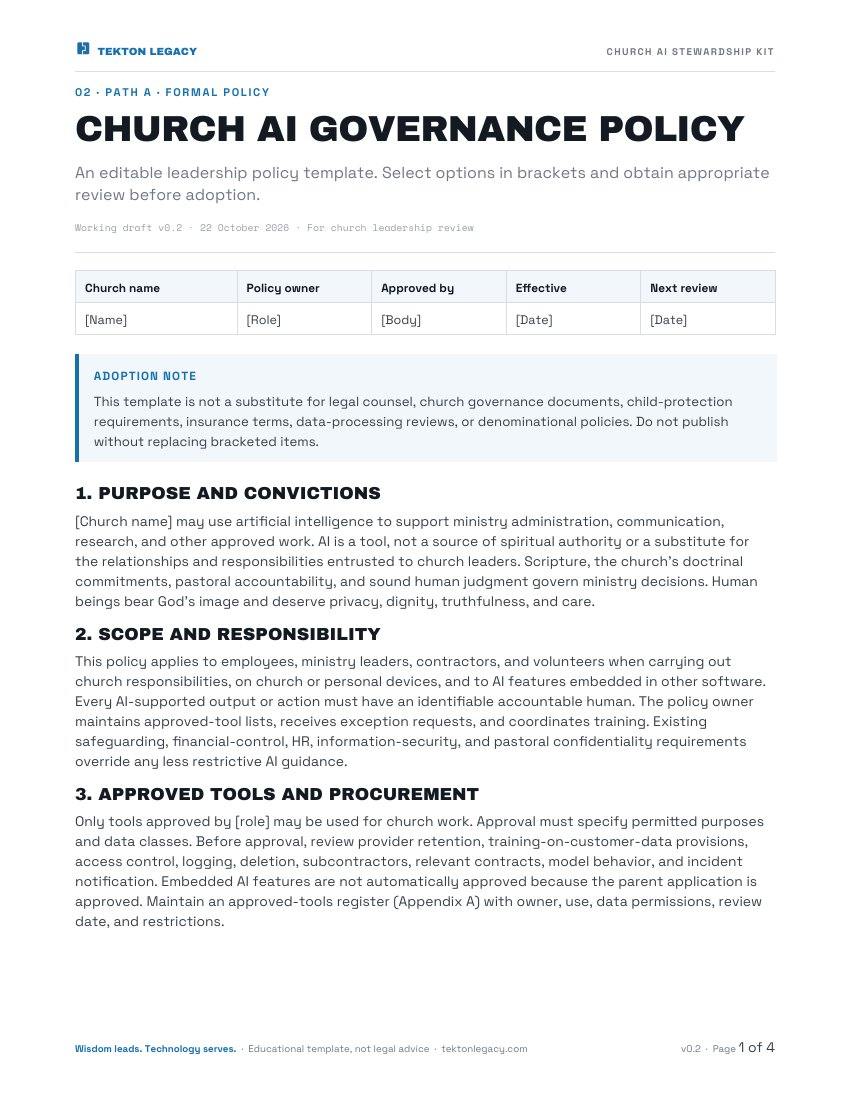
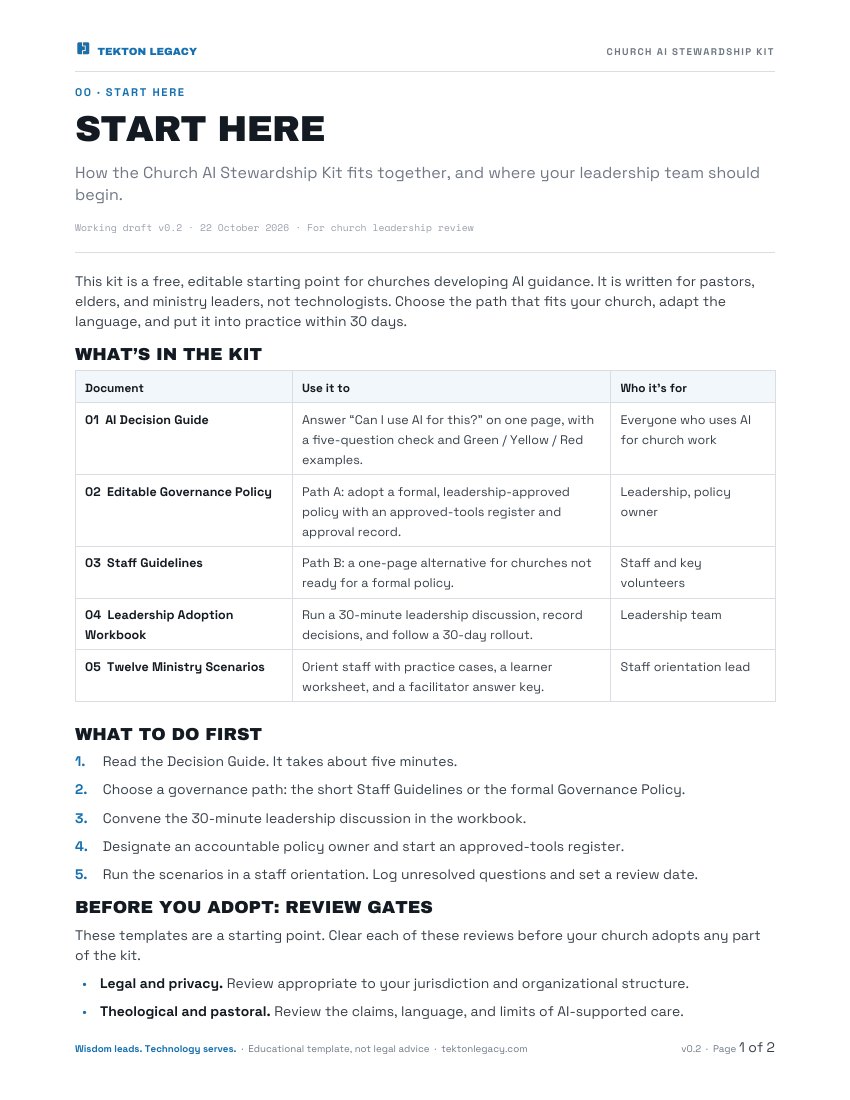
A free, editable starting point for churches developing AI guidelines. Choose the path that fits your church—formal policy or practical staff guidelines—then use the guide, workbook, and scenarios to put it into practice within 30 days.
Working draft for church leadership review. Not legal advice. Adapt and approve according to your church’s policies and applicable requirements.
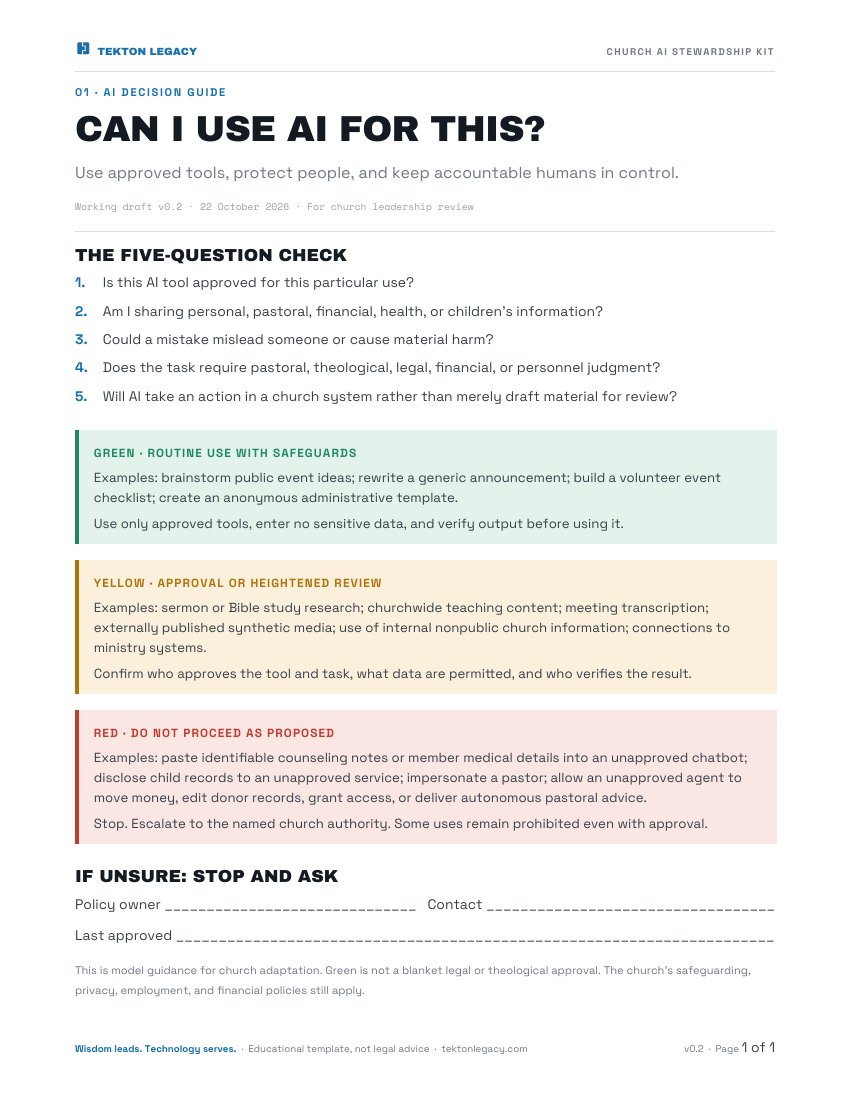
Four of the kit’s twelve ministry scenarios, with the facilitator’s answer. Ask the guide’s questions: is the tool approved, whose information is this, and could the AI act on its own? Then make the call.
These resources are a starting point, not the final word. We’re looking to learn alongside church leaders who are developing AI guidance, equipping staff, and discerning how technology can serve their ministries.